domingo, 12 de febrero de 2012

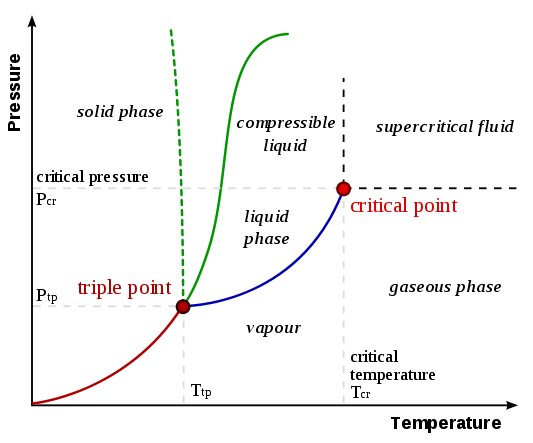
CHANGE OF PHASE

Watch these videos in You tube

Molecules in solids Eureka (http://youtu.be/AhBGMdhJ4nA)
Molecules in liquids Eureka(http://youtu.be/hxqEUy9Dusk)
Evaporation and Condensation Eureka(http://youtu.be/yyxc-81JDbo)
Phase changes (http://youtu.be/8mqoxGiuKeA)

Melting, or fusion, is a physical process that results in the phase change of a substance from a solid to a liquid.

Freezing or solidification is a phase change in which a liquid turns into a solid when its temperature is lowered below its freezing point. The reverse process is melting


Evaporation is a type of vaporization of a liquid that occurs only on the surface of a liquid. (The other type of vaporization is boiling, which, instead, occurs on the entire mass of the liquid)


Boiling is the rapid vaporization of a liquid, which occurs when a liquid is heated to its boiling point, the temperature at which the vapor pressure of the liquid is equal to the pressure exerted on the liquid by the surrounding environmental pressure. While below the boiling point a liquid evaporates from its surface, at the boiling point vapor bubbles come from the bulk of the liquid.


Condensation is the change of the physical state of matter from gaseous phase into liquid phase, and is the reverse of vaporization


Sublimation is the process of transition of a substance from the solid phase to the gas phase without passing through an intermediate liquid phase.

Deposition is a process in which gas transforms into solid (also known as desublimation). The reverse of deposition is sublimation.


SHOW YOUR KNOWLEDGE


Good Videos to understand this topic:

States of matter (http://youtu.be/HAPc6JH85pM)
The Phase Changes of Water Song - Mr. Edmonds (http://youtu.be/8eALQ2HP45I)
States of Matter and Phase Change (http://youtu.be/BjyXIZtlHFo)

lunes, 6 de febrero de 2012

PRESSURE

2 FAMILIAR EXAMPLES

A woman’s high heels sink into the soft ground, but the larger shoes of the much bigger man do not. Why? Becasue of pressure.

Another familiar example is the air pressure in a tire, which is typically around 30 psi for a car. What this means is that a force of 30 pounds is exerted on each and every square inch of surface area on the inside of the tire, There are a lot of square inches on the inside surface of a tire, and because of this, the force exerted on the tire is very large. Every square inch is pushed on with a force of 30 pounds!


What is pressure?

Pressure (the symbol: p) is the force per unit area applied in a direction perpendicular to the surface of an object
The physics definition is that pressure is force per unit area:      
Pressure = Force / Area

Units: The SI unit for pressure is the pascal (Pa), equal to one newton per square meter (N/m2).


Paul Hewitt demos pressure by having his assistant lie on a Bed of Nails and Paul hits a block of stone on assistant's chest with a sledge hammer.
Look the video in Youtube


For an object sitting on a surface, the force pressing on the surface is the weight of the object, but in different orientations it might have a different area in contact with the surface and therefore exert a different pressure.


Force in fluids

It is usually more convenient to use pressure rather than force to describe the influences upon fluid behavior.
The standard unit for pressure is the Pascal, which is a Newton per square meter.

Pascal's principle

Pressure is transmitted undiminished in an enclosed static fluid

The pressure exerted on the piston extends uniformly throughout the fluid, causing it to push outward with equal force per unit area on the walls and bottom of the cylinder.

Any externally applied pressure is transmitted to all parts of the enclosed fluid, making possible a large multiplication of force (hydraulic press principle).

The pressure at the bottom of the jug is equal to the externally applied pressure on the top of the fluid plus the static fluid pressure from the weight of the liquid.


Automobile Hydraulic Lift

A hydraulic lift for automobiles is an example of a force multiplied by hydraulic press, based on Pascal's principle.
The fluid in the small cylinder must be moved much further than the distance the car is lifted.

For example, if the lift cylinder were 25 cm in diameter and the small cylinder were 1.25 cm in diameter, then the ratio of the areas is 400, so the hydraulic press arrangement gives a multiplication of 400 times the force.
To lift a 6000 Newton car, you would have to exert only 6000 N/400 = 15 N on the fluid in the small cylinder to lift the car.
However, to lift the car 10 cm, you would have to move the oil 400 x 10cm = 40 meters. This is practical by pumping oil into this small cylinder with a small compressor.

REPASO REPASO REPASO REPASO REPASO REPASO REPASO REPASO REPASO REPASO REPASO REPASO REPASO REPASO REPASO REPASO REPASO REPASO REPASO REPASO REPASO REPASO REPASO REPASO REPASO REPASO REPASO REPASO REPASO REPASO

COLEGIO ANDES DE MAZATLÁN SECCIÓN SECUNDARIA
CIENCIAS 2 (FÍSICA) SEGUNDO GRADO

QUIZ 21. PRESIÓN

Alumn@: ___________________________________________ Calif.: _____

I. Selecciona la respuesta correcta:

1. Es la fuerza aplicada por cada unidad de área. Los fakires saben como usar este concepto para ofrecer un espectáculo al público
A) Trabajo B) Viscosidad C) Presión D) Densidad

2. Es la presión que ejerce el aire de la atmósfera sobre cada lugar geográfico. La altitud de los lugares está relacionada con la PA. A menor altitud mayor presión, y viceversa
A) Marina B) Hidráulica C) Atmosférica D) De altitud

3. Instrumento que sirve para medir la presión atmosférica, es decir, la fuerza por unidad de área ejercida por el peso de la atmósfera.
A) Termostato B) Barómetro C) Densímetro D) Báscula

4. ¿En qué dirección actúan los cambios de presión que se ejercen sobre cualquier punto en un fluido? Fluye en…
A) En todas direcciones B) En la horizontal. C) En la paralela. D) la vertical.

5. La figura representa a muchos de los mecanismos hidráulicos como el freno, la dirección y el elevador que se utilizan en los talleres mecánicos y los cuales funcionan bajo el siguiente principio: la presión que hacemos en un punto cualquiera de un fluido se transmite instantáneamente y con la misma intensidad a todos los puntos del fluido. Esto fue propuesto por:
A) Robert Boyle B) Charles
C) Arquímedes D) Blaise Pascal

6. Al aplicar una fuerza de 10 N con un dedo sobre la plastilina, la cual tiene un área de 0.05 m2, ¿cuál será la presión ejercida? Fórmula: Presión = Fuerza / Área
A) 20 Pa B) 2.0 Pa C) 0.5 Pa D) 200 Pa

7. Si aplicamos una fuerza de 1000 Newtons sobre el área de 2 m2, la presión ejercida se difundirá sobre todo el fluido y será de:
A) 2000 N/m2 B) 500 N/m2 C) 1002 N/m2 D) 0.02 N/m2

8. El émbolo menor de una prensa hidráulica mide 20 cm2 y el émbolo mayor 50 cm2 de área. ¿Qué fuerza se obtendrá en el émbolo mayor si se coloca sobre el émbolo menor un cuerpo cuya fuerza es de 147 N?
Fórmula F1/A1 = F2/A2
A) 294 N B) 255 N C) 367.5 N D) 400 N

9. Principio que afirma: “Todo objeto sumergido en un fluido experimenta un empuje hacia arriba igual al peso del volumen del fluido desalojado”.
A) Pascal B) Volta C) Arquímedes D) Coulomb

10. ¿Cómo es la fuerza de empuje que recibe un objeto sumergido en un fluido?
A) Igual al peso del fluido desplazado.
B) Igual a la altura del fluido desplazado.
C) Igual al volumen del fluido desplazado.
D) Igual a la capacidad del fluido desplazado.

jueves, 2 de febrero de 2012

Heat transfer

Temperature is a measure of the ability of a substance, or more generally of any physical system, to transfer heat energy to another physical system. The higher the temperature of an object is, the greater the tendency of that object to transfer heat. The lower the temperature of an object is, the greater the tendency of that object to be on the receiving end of the heat transfer.

What is Thermal energy?

Thermal energy is the TOTAL potential & kinetic ENERGY of all the particles in an object.
Three factors determine an object’s Thermal energy:
Mass: More quantity particles  More Thermal Energy
Temperature: More motion - average kinetic energy  More Thermal Energy
Phase: Gases > Liquids > Solids

Heat is the transfer of thermal energy from a warmer object to a cooler object.
This transfer is due to a difference in the temperature.
Heat is energy in motion
Units to measure Heat: Joules, Calories

Heat travels by 3 different methods

Conduction: The mechanism in which heat is transferred from one object to another object through particle collisions is known as conduction. In conduction, there is no net transfer of physical stuff between the objects. Nothing material moves across the boundary. The changes in temperature are wholly explained as the result of the gains and losses of kinetic energy during collisions.

Heat Transfer by Convection: Heat typically does not flow through liquids and gases by means of conduction.
Liquids and gases are fluids; their particles are not fixed in place; they move about the bulk of the sample of matter. The model used for explaining heat transfer through the bulk of liquids and gases involves convection.
Convection is the process of heat transfer from one location to the next by the movement of fluids. The moving fluid carries energy with it. The fluid flows from a high temperature location to a low temperature location.

Heat Transfer by Radiation: A final method of heat transfer involves radiation. Radiation is the transfer of heat by means of electromagnetic waves. To radiate means to send out or spread from a central location. Whether it is light, sound, waves, rays, flower petals, wheel spokes or pain, if something radiates then it protrudes or spreads outward from an origin.
The transfer of heat by radiation involves the carrying of energy from an origin to the space surrounding it. The energy is carried by electromagnetic waves and does not involve the movement or the interaction of matter.
Thermal radiation can occur through matter or through a region of space that is void of matter (i.e., a vacuum). In fact, the heat received on Earth from the sun is the result of electromagnetic waves traveling through the void of space between the Earth and the sun.

Check Your Understanding

1. Consider Object A which has a temperature of 65°C and Object B which has a temperature of 15°C. The two objects are placed next to each other and the little bangers begin colliding. Will any of the collisions result in the transfer of energy from Object B to Object A? Explain.

Answer: Most certainly yes. The average kinetic energy of the particles in Object A is greater than the average kinetic energy of the particles in Object B. But there is a range of speeds and thus of kinetic energy in both objects. As such, there will be some highly energetic particles in Object B and some very non-energetic particles in Object A. When this combination of particles encounter a collision, there will a transfer of energy across the boundary from Object B (the colder object) to Object A (the hotter object). This is just one collision. Since majority of collisions result from the more energetic particles of Object A with less energetic particles of collision B, there will be a net kinetic energy transfer from Object A to Object B.

2. Suppose that Object A and Object B (from the previous problem) have reached a thermal equilibrium. Do the particles of the two objects still collide with each other? If so, do any of the collisions result in the transfer of energy between the two objects? Explain.

Answer: The collisions will still take place because the particles are still moving. Just because the temperatures are the same doesn't mean the collisions will stop. The fact that the temperature is identical means that the average kinetic energy of all the particles is the same for both objects. As such, there will be just as much energy transferred from Object B to Object A as there is energy transferred in the opposite direction. When the effect of these collisions is averaged, there is no net energy transfer. This explains why the temperature of the two objects remains the same. Thermal equilibrium persists.

REPASO REPASO REPASO REPASO REPASO REPASO REPASO REPASO REPASO REPASO REPASO REPASO REPASO REPASO REPASO REPASO REPASO REPASO REPASO REPASO REPASO REPASO REPASO REPASO REPASO REPASO REPASO REPASO REPASO REPASO REPASO REPASO REPASO REPASO REPASO REPASO REPASO REPASO REPASO REPASO

COLEGIO ANDES DE MAZATLÁN SECCIÓN SECUNDARIA
CIENCIAS 2 (FÍSICA) SEGUNDO GRADO

QUIZ 20. CALOR Y ENERGÍA

Alumn@: ___________________________________________ Calif.: _____

I. Selecciona la respuesta correcta:

1. Es una manifestación de la energía provocada por el movimiento molecular.
A) Trabajo B) Temperatura C) Calor D) Presión

2. ¿Qué nombre recibe la cantidad de energía térmica que un cuerpo pierde o gana en contacto con otro a diferentes temperaturas?
A) Trabajo B) Temperatura C) Calor D) Presión

3. El calor es:
A) Proporcional a la pérdida de energía B) Energía térmica en movimiento
C) Se mide con un termómetro D) Su unidad es el Pascal (Pa)

4. Cantidad de calor que es necesario aplicar a un gramo de cualesquiera sustancia para elevar su temperatura en un grado centígrado.
A) Caloría B) Joule C) Newton D) BTU

5. Propagación del calor presente en las corrientes marinas y los vientos debido a la diferencia de temperaturas.
A) Conducción B) Convección C) Radiación D) Refracción

6. Dispositivo que usamos cotidianamente para conservar “el calor” o “el frío”, ya que reduce al máximo la conducción, la convección y la radiación del calor.
A) Termo B) Olla presto C) Refrigerador D) Horno

7. Es todo dispositivo que transforma calor en trabajo, como los motores de combustión interna o externa, y las máquinas de refrigeración.
A) Reproductor CD B) Termostato C) Máquina térmica D) Batería

8. ¿Por qué algunos materiales se calientan más rápido que otros?


9. ¿Aumenta la temperatura de un cuerpo cuando se le transfiere energía mediante trabajo mecánico?


10. Un refrigerador disminuye la temperatura de los alimentos que se encuentran en su interior; ¿podemos decir que el refrigerador transfiere frío a los alimentos?, ¿por qué?

lunes, 23 de enero de 2012

Temperature

Find the complete information with images at:

http://www.physicsclassroom.com/Class/thermalP/

Lesson 01: Heat and Temperature. a, b & c.

Eureka! Video Thermal Expansion & Contraction http://youtu.be/I7w_Qv5_h4c
Using balloons to illustrate the process, Eureka! shows how, when matter gets hot, its molecules go faster and the solid, liquid, or gas expands. Conversely, when matter gets cold, its molecules go slower, and the solid, liquid, or gas contracts.

Eureka! Video Measuring Temperature http://youtu.be/YWJHNG5y5F0
Eureka! shows viewers how Swedish scientist Anders Celsius invented the Celsius thermometer, using the expansion of mercury as a measure of temperature

Temperature and Thermometers
We all have a feel for what temperature is. We even have a shared language that we use to qualitatively describe temperature. The water in the shower or bathtub feels hot or cold or warm. The weather outside is chilly or steamy. We certainly have a good feel for how one temperature is qualitatively different than another temperature. We may not always agree on whether the room temperature is too hot or too cold or just right. But we will likely all agree that we possess built-in thermometers for making qualitative judgments about relative temperatures.

What is Temperature?
Despite our built-in feel for temperature, it remains one of those concepts in science that is difficult to define. It seems that a tutorial page exploring the topic of temperature and thermometers should begin with a simple definition of temperature. But it is at this point that I'm stumped. So I turn to that familiar resource, Dictionary.com ... where I find definitions that vary from the simple-yet-not-too-enlightening to the too-complex-to-be-enlightening. At the risk of doing a belly flop in the pool of enlightenment, I will list some of those definitions here:

•The degree of hotness or coldness of a body or environment.
•A measure of the warmth or coldness of an object or substance with reference to some standard value.
•A measure of the average kinetic energy of the particles in a sample of matter, expressed in terms of units or degrees designated on a standard scale.
•A measure of the ability of a substance, or more generally of any physical system, to transfer heat energy to another physical system.
•Any of various standardized numerical measures of this ability, such as the Kelvin, Fahrenheit, and Celsius scale.


Celsius Temperature Scale

The thermometer calibration process described above results in what is known as a centigrade thermometer. A centigrade thermometer has 100 divisions or intervals between the normal freezing point and the normal boiling point of water. Today, the centigrade scale is known as the Celsius scale, named after the Swedish astronomer Anders Celsius who is credited with its development. The Celsius scale is the most widely accepted temperature scale used throughout the world. It is the standard unit of temperature measurement in nearly all countries, the most notable exception being the United States. Using this scale, a temperature of 28 degrees Celsius is abbreviated as 28°C.

Fahrenheit temperature scale

Traditionally slow to adopt the metric system and other accepted units of measurements, the United States more commonly uses the Fahrenheit temperature scale. A thermometer can be calibrated using the Fahrenheit scale in a similar manner as was described above. The difference is that the normal freezing point of water is designated as 32 degrees and the normal boiling point of water is designated as 212 degrees in the Fahrenheit scale. As such, there are 180 divisions or intervals between these two temperatures when using the Fahrenheit scale. The Fahrenheit scale is named in honor of German physicist Daniel Fahrenheit. A temperature of 76 degree Fahrenheit is abbreviated as 76°F. In most countries throughout the world, the Fahrenheit scale has been replaced by the use of the Celsius scale.

Temperatures expressed by the Fahrenheit scale can be converted to the Celsius scale equivalent using the equation below:

°C = (°F - 32°)/1.8

Similarly, temperatures expressed by the Celsius scale can be converted to the Fahrenheit scale equivalent using the equation below:

°F= 1.8•°C + 32°


The Kelvin Temperature Scale

While the Celsius and Fahrenheit scales are the most widely used temperature scales, there are several other scales that have been used throughout history. For example, there is the Rankine scale, the Newton scale and the Romer scale, all of which are rarely used. Finally, there is the Kelvin temperature scale, which is the standard metric system of temperature measurement and perhaps the most widely used temperature scale used among scientists. The Kelvin temperature scale is similar to the Celsius temperature scale in the sense that there are 100 equal degree increments between the normal freezing point and the normal boiling point of water. However, the zero-degree mark on the Kelvin temperature scale is 273.15 units cooler than it is on the Celsius scale. So a temperature of 0 Kelvin is equivalent to a temperature of -273.15 °C. Observe that the degree symbol is not used with this system. So a temperature of 300 units above 0 Kelvin is referred to as 300 Kelvin and not 300 degree Kelvin; such a temperature is abbreviated as 300 K. Conversions between Celsius temperatures and Kelvin temperatures (and vice versa) can be performed using one of the two equations below.

°C = K - 273.15°

K = °C + 273.15

REPASO REPASO REPASO REPASO REPASO REPASO REPASO REPASO REPASO REPASO REPASO REPASO REPASO REPASO REPASO REPASO REPASO REPASO REPASO REPASO

COLEGIO ANDES DE MAZATLÁN SECCIÓN SECUNDARIA
CIENCIAS 2 (FÍSICA) SEGUNDO GRADO

QUIZ 19. TEMPERATURA

Alumn@: ___________________________________________ Calif.: _____

I. Selecciona la respuesta correcta:

1. Cuando un objeto se calienta aumenta el movimiento de las partículas (átomos y moléculas) que lo conforman. Por lo tanto, la medida de la energía cinética promedio de las partículas corresponde a:
A) La temperatura B) La presión C) La dilatación D) El calor

2. Al calentar un cuerpo, aumenta la energía cinética de las moléculas, produciéndose choques más o menos violentos, según la cantidad de calor entregada. Al valor promedio de ese movimiento de partículas se le denomina:
A) Solubilidad B) Energía térmica
C) Temperatura D) Inercia

3. Observa la siguiente gráfica que describe el cambio de longitud de un tubo de hierro con la temperatura: ¿Cuál es la longitud aproximada del tubo a una temperatura de 80 °C?
A) 300.30 m B) 300.25 m
C) 300.23 m D) 300.20 m

4. ¿Por qué dos cuerpos de distinto material a la misma temperatura se llegan a sentir uno más caliente que otro?
A) Por la forma como se conduce el calor a través de ellos.
B) Por la forma como cada uno alcanza la temperatura del lugar.
C) Por la forma como se emite el calor en cada uno de los materiales.
D) Por la forma como la temperatura de uno modifica a la del otro.

5. ¿Por qué la Torre Eiffel de París, que está construida con piezas metálicas, tiene una altura mayor cuando la temperatura es muy alta en verano?
A) Porque debido a la alta absorción de calor por el metal, éste se dilata y aumenta de tamaño.
B) Porque debido a la alta emisión de calor por el metal, éste se dilata y aumenta de tamaño.
C) Porque debido a que la energía absorbida y emitida por el metal es igual, éste se dilata y aumenta de tamaño.
D) Porque debido a que la energía calorífica cedida es menor que la temperatura, el metal se dilata y aumenta de tamaño.

6. Líquido que se utiliza en la construcción de termómetros debido a su propiedad de expansión térmica uniforme.
A) Agua B) Cloro C) Bromo D) Mercurio

7. ¿Cómo miden los termómetros la temperatura?

8. Una persona enferma tiene fiebre de 40°C, ¿a qué temperatura corresponde el valor en grado Fahrenheit?
A) 104 °F B) 273 °F C) 32 °F D) -104 °F

9. El cero absoluto es una temperatura teórica donde no existe ningún movimiento en las partículas de la materia. ¿Cuánto vale el cero absoluto en grados centígrados?
A) -273 °C B) 0 °C C) 37 °C D) 100 °C

10. ¿A cuántos grados Fahrenheit equivale el que un día tenga una temperatura ambiente de 32 °C? Utiliza la fórmula °F = 1.8*(°C) + 32
A) 32°C B) 64°C C) 57.6 °C D) 89.6 °C

lunes, 16 de enero de 2012

Mass, Volume and Density

VISIT www.brainpop.com/science AND WATCH INTERESTING VIDEOS ABOUT SCIENCE.

www.brainpop.com/science/matterandchemistry/measuringmatter/preview.weml


BASIC PROPERTIES OF MATTER EXPLAINED WITH THE KINETIC PARTICLES MODEL

What are mass, volume & density?
Why are they important?


En el modelo cinético de partículas se consideran características básicas (partículas indivisibles con movimiento continuo en el vacío) para interpretar algunas propiedades de la materia, como la masa, el volumen, la densidad, los estados físicos y la temperatura

SEPyC Expected learning

Describe algunas propiedades de la materia: masa, volumen, densidad y estados de agregación, a partir del modelo cinético de partículas

Initial question

What should be the characteristics of the materials used in the job of construction?


What is everything made of? Matter

* Matter is anything in the universe that takes a place in the space.
* It makes everything you can see, feel, taste or touch.
* Mass, volume and density are all physical properties of matter.
* They are measurements that we can take from material objects.

01 MASS

What is mass?

Is the measurement of how much matter an object contains.


02 VOLUME

03 DENSITY

VISIT

http://www.brainpop.com/science/motionsforcesandtime/buoyancy/

Why do you think that the same volume of different materials have differing masses?

For Example 1cm3 of gold weighs 19.3g but 1cm3 of aluminium weighs 2.7g

POWER POINT PRESENTATION SLIDES


REVIEW REVIEW REVIEW REVIEW REVIEW REVIEW REVIEW REVIEW REVIEW REVIEW REVIEW REVIEW REVIEW REVIEW REVIEW REVIEW REVIEW REVIEW REVIEW REVIEW REVIEW REVIEW REVIEW REVIEW REVIEW REVIEW REVIEW REVIEW REVIEW REVIEW

COLEGIO ANDES DE MAZATLÁN SECCIÓN SECUNDARIA
CIENCIAS 2 (FÍSICA) SEGUNDO GRADO

CARACTERÍSTICAS DE LA MATERIA

I. Selecciona la respuesta correcta:

1. Todo lo que somos físicamente y lo que nos rodea, se encuentra en algún estado de agregación, los cuales comparten características generales, tales como:
A) Masa, peso y volumen B) Maleabilidad y densidad
C) Elasticidad y porosidad D) Viscosidad y ductilidad

2. Es todo aquello de lo que están hechos los cuerpos y las cosas, ocupan un lugar en el espacio y se pueden percibir con los sentidos.
A) Volumen B) Materia C) Masa D) Peso

3. ¿Por qué al sopesar con ambas manos un kilogramo de algodón y un kilogramo de fierro se siente más ligero el algodón?
A) Porque el algodón es más denso que el fierro.
B) Porque el algodón es menos denso que el fierro.
C) Porque el algodón es más voluminoso que el fierro.
D) Porque el algodón es menos voluminoso que el fierro.

I. Masa W. m3
II. Volumen X. Kg
III. Densidad Y. °C
IV. Temperatura Z. g/cm3

4. Identifiquen las propiedades de la materia y la unidad de medida que les corresponde:
A) I Z, II Y, III X, IV W B) I X, II W, III Y, IV Z
C) I Y, II Z, III X, IV W D) I X, II W, III Z, IV Y

5. Observa la siguiente tabla que representa algunos datos que obtuvo Carlos al realizarse un examen médico: ¿Cuál dato corresponde a una medida de longitud?
A) El peso. B) La estatura.
C) La temperatura. D) El tiempo de consulta.

6. Don Alfonso tiene a la venta 3 m3 de aluminio, ¿Cuál es su masa si su densidad es 2.7 g/cm3?
A) 8.1 kg B) 5.7 kg C) 1.1 kg D) 0.3 kg

7. Se define como la resistencia que oponen los líquidos a fluir.
A) Tensión B) Fricción C) Densidad D) Viscosidad

8. ¿Cómo se le conoce a la propiedad de los líquidos que permite a algunos objetos mantenerse en la superficie sin hundirse?
A) Tensión superficial B) Capilaridad
C) Resistencia al flujo D) Viscosidad

9. La densidad es una propiedad física de la materia. ¿Quién es más denso: el agua o el aire? ¿Cuál es la fórmula para determinar la densidad?
A) El agua. La fórmula de densidad es D= M/V.
B) El aire. La fórmula de densidad es D = M/V.
C) El aire. La fórmula de densidad es V = DT.
D) El agua. La fórmula de densidad es V = D/T.

10. ¿En cuál de las siguientes situaciones se aplica la Ley de la conservación de la materia?
A) Cuando se quema una hoja de papel. B) Cuando se destapa un refresco.
C) Cuando se exprime un limón. D) Cuando se infla un globo.

miércoles, 11 de enero de 2012

Kinetic Particles Model

Aspectos básicos del (MCP) Modelo Cinético de Partículas:

Aprendizaje esperado:
Describe los aspectos básicos que conforman el modelo cinético de partículas y explica el efecto de la velocidad de éstas.
Las partículas son
*microscópicas
*indivisibles,
*con masa,
*movimiento,
*interacciones y
*vacío entre ellas.


History of Atomic Structure

The search for the atom began as a philosophical question. It was the natural philosophers of ancient Greece that began the search for the atom by asking such questions as: What is stuff composed of? What is the structure of material objects? Is there a basic unit from which all objects are made? As early as 400 B.C., some Greek philosophers proposed that matter is made of indivisible building blocks known as atomos. (Atomos in Greek means indivisible.) To these early Greeks, matter could not be continuously broken down and divided indefinitely. Rather, there was a basic unit or building block that was indivisible and foundational to its structure. This indivisible building block of which all matter was composed became known as the atom.

The early Greeks were simply philosophers. They did not perform experiments to test their theories. In fact, science as an experimental discipline did not emerge as a credible and popular practice until sometime during the 1600s. So the search for the atom remained a philosophical inquiry for a couple of millennia. From the 1600s to the present century, the search for the atom became an experimental pursuit. Several scientists are notable; among them are Robert Boyle, John Dalton, J.J. Thomson, Ernest Rutherford, and Neils Bohr.

KINETIC PARTICLES MODEL


The kinetic theory of matter (particle theory) says that all matter consists of many, very small particles which are constantly moving or in a continual state of motion.

The degree to which the particles move is determined by the amount of energy they have and their relationship to other particles.

The particles might be atoms, molecules or ions. Use of the general term 'particle' means the precise nature of the particles does not have to be specified.

Particle theory helps to explain properties and behaviour of materials by providing a model which enables us to visualise what is happening on a very small scale inside those materials. As a model it is useful because it appears to explain many phenomena but as with all models it does have limitations.


Diffusion

Diffusion gives us more evidence for our kinetic model
Diffusion is the spreading out of particles when they are free to move in a fluid (liquid or gas).

Task:
Observe the experiments in Physics for you pp17, and explin how they give us evidence for molecular movement in liquids and gases.


The model can be used to help explain:

1. The properties of matter
3. Heat & Temperature phenomena
Pressure phenomena
What happens during physical changes such as melting, boiling and evaporating


3 States of Matter


SOLID

In solids the particles are close together and have limited motion.

In solids the particles:

- are held tightly and packed fairly close together - they are strongly attracted to each other
- are in fixed positions but they do vibrate

LIQUID

In a liquid some of the attraction between particles is overcome which allows the particles more freedom of movement.

In liquids the particles:

- are fairly close together with some attraction between them
- are able to move around in all directions but movement is limited by attractions between particles

GAS

In a gas particles attraction between particles is minimized and the particles move freely throughout the container.

In gases the particles:

-have little attraction between them
- are free to move in all directions and collide with each other and with the walls of a container and are widely spaced out


Postulates of KPM

(i) Every gas consists of a large number of small particles called molecules moving with very high velocities in all possible directions.
(ii) The volume of the individual molecule is negligible as compared to the total volume of the gas.
(iii) Gaseous molecules are perfectly elastic so that there is no net loss of kinetic energy due to their collisions.
(iv) The effect of gravity on the motion of the molecules is negligible.
(v) Gaseous molecules are considered as point masses because they do not posses potential energy. So the attractive and repulsive forces between the gas molecules are negligible.
(vi) The pressure of a gas is due to the continuous bombardment on the walls of the containing vessel.
(vii) At constant temperature the average K.E. of all gases is same.
(viii) The average K.E. of the gas molecules is directly proportional to the absolute temperature.


Clausius, Maxwell y Boltzmann

Kinetic theory of gases was developed by Clausius, Maxwell and Boltzmann etc. and represents dynamic particle or microscopic model for different gases since it throws light on the behaviour of the particles (atoms and molecules) which constitute the gases and cannot be seen.


REVIEW REVIEW REVIEW REVIEW REVIEW REVIEW REVIEW REVIEW REVIEW REVIEW REVIEW REVIEW REVIEW REVIEW REVIEW REVIEW REVIEW REVIEW REVIEW REVIEW REVIEW REVIEW REVIEW REVIEW REVIEW REVIEW REVIEW REVIEW REVIEW REVIEW

COLEGIO ANDES DE MAZATLÁN SECCIÓN SECUNDARIA
CIENCIAS 2 (FÍSICA) SEGUNDO GRADO

QUIZ 18. EL MODELO CINÉTICO DE PARTÍCULAS

Alumn@: ___________________________________________ Calif.: _____

1. De los estados de agregación de la materia. ¿En cuál sus partículas están siempre juntas dándole una forma definida?
A) Sólido B) Líquido C) Gas D) Plasma

2. El estado de agregación sólido (hielo) del agua, se diferencia del líquido (agua) y del gaseoso (vapor) debido a que:
A) Las partículas que lo forman están ligeramente separadas y toman la forma del recipiente que las contiene.
B) Las partículas están totalmente separadas y no tienen fuerza.
C) Las partículas están estrechamente unidas y le proporcionan forma propia.
D) Sus partículas se expanden fácilmente y chocan con fuerza sobre las paredes del recipiente que las contiene.

3. Imagina que calentamos un trozo de hielo que está a una temperatura inicial de -60°C. Cuando la temperatura del hielo llegue a 0°C, se empezará a derretir. De seguir calentando el agua, sus moléculas se:
A) Desaparecen B) Adhieren C) Comprimen D) Separan

4. ¿Cuál de las siguientes propiedades de los gases es correcta y se manifiesta en un globo aerostático?
A) La velocidad de sus moléculas aumenta cuando la temperatura sube y disminuye cuando baja.
B) Las moléculas de un gas se mueven constantemente, su velocidad es baja y su trayectoria es recta.
C) Las moléculas chocan continuamente unas con otras y contra las paredes del recipiente, perdiendo energía cinética.
D) Las moléculas están juntas unas con otras, el volumen individual es mucho mayor en comparación con el volumen total del gas.

5. Propiedad que caracteriza a las sustancias líquidas.
A) Adquieren la forma del recipiente que los contiene
B) Conserva siempre su forma.
C) Su volumen cambia según el recipiente que los contiene.
D) Se puede romper.

6. Raúl y su equipo se usaron el modelo de partículas y se apoyaron en las aportaciones de Newton y Boltman en el desarrollo del modelo cinético de partículas de acuerdo a dos aspectos básicos:
A) El movimiento y las colisiones entre las partículas de los gases.
B) El movimiento y el vacío que se forma en el cambio de estado de los gases.
C) La forma y el volumen del recipiente que contiene a los gases.
D) La densidad de las partículas de los gases y el volumen del recipiente que los contiene.

7. Mario colocó un globo en un vaso con agua caliente y éste se infló porque:
A) Las partículas de vapor de agua caliente se mueven lentamente.
B) Sólo existen partículas de aire moviéndose dentro en el globo.
C) Se infla por el movimiento de partículas de aire caliente y vapor de agua.
D) Las partículas del vapor de agua se separan y forman un vacío.

8. Haz un dibujo del acomodo de las partículas en cada estado de la materia.

9. Describe el movimiento de las partículas en los 3 estados (Sólido, Líquido y Gaseoso)

10. A diferencia de los sólidos, un gas...
A) Mantendrá su volumen en diferentes contenedores
B) Mantendrá su forma en diferentes contenedores
C) Se expandirá hasta llenar el espacio disponible.
D) Disminuirá su volumen cuando su temperatura se eleve.

lunes, 2 de enero de 2012

Using models in Science

UNIT 3:

Este bloque se centra en el análisis del modelo cinético de partículas, para que los alumnos describan y expliquen algunas características y procesos físicos de la materia que son observables a simple vista. Esta perspectiva contribuye a la construcción de representaciones en los alumnos, de manera que tengan bases para comprender la naturaleza discontinua de la materia y sus interacciones.

Se propone la revisión histórica de las diferentes ideas acerca de la estructura de la materia hasta la construcción del modelo cinético de partículas; con ello, los alumnos podrán identificar su funcionalidad y limitaciones, además de reflexionar en torno a la evolución de las ideas en la ciencia.


En el modelo cinético de partículas se consideran características básicas (partículas indivisibles con movimiento continuo en el vacío) para
1. interpretar algunas propiedades de la materia, como la masa, el volumen, la densidad, los estados físicos y la temperatura,
2. así como interacciones relacionadas con la presión, procesos térmicos y el cambio de estado físico;

Por último, se vinculan los procesos térmicos con la energía, en función de su transformación, transferencia y conservación, lo que da pie a la reflexión acerca del aprovechamiento e implicaciones de ésta. En este bloque, las actividades experimentales constituyen un recurso para que los alumnos expliciten sus ideas, las prueben y las relacionen con el modelo.

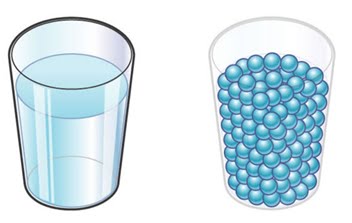
1. Models in Science (What are scientific models used for?)

1. Características e importancia de los modelos en la ciencia.

Aprendizaje esperado:
Identifica las características de los modelos y los reconoce como una parte fundamental del conocimiento científico y tecnológico, que permiten describir, explicar o predecir el comportamiento del fenómeno estudiado.
WHAT IS A MODEL?

1. A small object, usually built to scale, that represents in detail another, often larger object.
2. a. A preliminary work or construction that serves as a plan from which a final product is to be made: a clay model ready for casting.
b. Such a work or construction used in testing or perfecting a final product: a test model of a solar-powered vehicle.
3. A schematic description of a system, theory, or phenomenon that accounts for its known or inferred properties and may be used for further study of its characteristics: a model of generative grammar; a model of an atom; an economic model.
4. A style or design of an item: My car is last year's model.
5. One serving as an example to be imitated or compared: a model of decorum. See Synonyms at ideal.
6. One that serves as the subject for an artist, especially a person employed to pose for a painter, sculptor, or photographer.
7. A person employed to display merchandise, such as clothing or cosmetics.
8. Zoology An animal whose appearance is copied by a mimic.

Models are useful to
Describe characteristics (by relating concepts),
Explain behavior (by drawing graph) and
predict changes in future (by applying a formula) in objects or phenomena subject of study.


2. IDEAS OF MATTER (What is matter made of?)

2. Ideas en la historia acerca de la naturaleza continua y discontinua de la materia:
Aprendizaje esperado: Reconoce el carácter inacabado de la ciencia a partir de las explicaciones acerca de la estructura de la materia, surgidas en la historia, hasta la construcción del modelo cinético de partículas.
Demócrito, Aristóteles y Newton; aportaciones de Clausius, Maxwell y Boltzmann

Democritus (Greek era):
Very old idea 450 BC Ancient Greece: Democritus/Leucippus
"Any substance could be subdivided until an indivisible atomos was reached"
The idea was not tested and was later forgotten.
"by convention bitter, by convention sweet, but in reality atoms and void"

Aristotle:
350 BC Ancient Greece: Aristotle
"All matter was classified into combinations of 4 elements, earth, water, air and fire"

Aristóteles (384-322 a. C.) creía que todo lo que existía en el universo tenía un orden: “hay un lugar para cada cosa, y cada cosa en su lugar”. Para este filósofo en el mundo celeste, de los astros, solamente existía un elemento, el éter, perfecto e inmutable.
En el otro mundo, llamado sublunar, correspondiente a la superficie terrestre, todo estaba formado por mezclas imperfectas de los cuatro elementos tradicionales: tierra, agua, aire y fuego, los cuales, según otros filósofos griegos, eran combinaciones de cuatro principios fundamentales: lo frío y lo caliente, lo seco y lo húmedo, de tal manera que:
- El elemento tierra es frío y seco. Su contrario, el aire, es húmedo y caliente.
- El agua es fría y húmeda; su contrario, el fuego, es seco y caliente.


Issac Newton:
1665 England: Newton formulated laws of motion.
Proposed a mechanical universe with small solid masses in motion.
Matter was composed of various combinations of different "corpuscules" or atoms

Newton (1642 – 1727), en su obra titulada Óptica, explica que los objetos luminosos emiten partículas o corpúsculos luminosos, ya que la luz viaja en línea recta, como lo demuestra el hecho de que un objeto iluminado produce sombras. Señalaba que un rayo estaba formado por un chorro de átomos, de cuya naturaleza dependía el color. Supuso que la materia debía estar formada por partículas sólidas, duras, impenetrables y móviles con determinadas figuras y tamaños.

Por otra parte, la explicación del vacío, es decir de espacio en el que no hay materia, fue aceptada por algunos científicos que diseñaron experimentos para probarlo, en tanto que otros rechazaban la idea. Para Newton, era evidente que el universo estaba constituido por unos inmensos espacios vacíos entre los cuerpos celestes.

Clausius, Maxwell y Boltzmann:
Kinetic theory of gases was developed by Clausius, Maxwell and Boltzmann etc. and represents dynamic particle or microscopic model for different gases since it throws light on the behaviour of the particles (atoms and molecules) which constitute the gases and cannot be seen.

REVIEW REVIEW REVIEW REVIEW REVIEW REVIEW REVIEW REVIEW REVIEW

1. El uso de modelos de los estados de agregación del agua son un ejemplo de la importancia que éstos tienen en el desarrollo del conocimiento científico porque:
A) Son representaciones que implican leyes, que permiten realizar explicaciones y predicciones acerca de los objetos o procesos.
B) Son representaciones y explicaciones exactas de la realidad.
C) Permiten explicar sencillamente los fenómenos sin el uso de fundamentos científicos.
D) Sólo sirven para presentar dibujos o esquemas sin necesidad de recurrir a leyes o teorías.

2. ¿La ley de Gravitación Universal de Newton es un modelo? Explica

3. ¿Consideras que los científicos pueden utilizar modelos distintos para explicar el mismo fenómeno?

4. Da algunos ejemplos de modelos para explicar fenómenos biológicos o de otras áreas distintas a la Física.

5. La materia, ¿está hecha por pedacitos o es continua?

6. ¿Cómo se emplean los modelos para comprender las propiedades de la materia?

7. ¿Cómo consideraban los griegos que estaba formada la materia? ¿Por qué consideras que estas ideas perduraron durante años?

8. ¿Qué pensaba Aristóteles sobre la estructura de la materia?

9. ¿Qué pensaba Isaac Newton sobre la estructura de la materia?

10. A través del desarrollo de la ciencia y la tecnología el hombre realiza representaciones para describir los sistemas físicos o fenómenos naturales, a los que denomina:
A) Inferencias B) Hipótesis C) Tesis D) Modelos